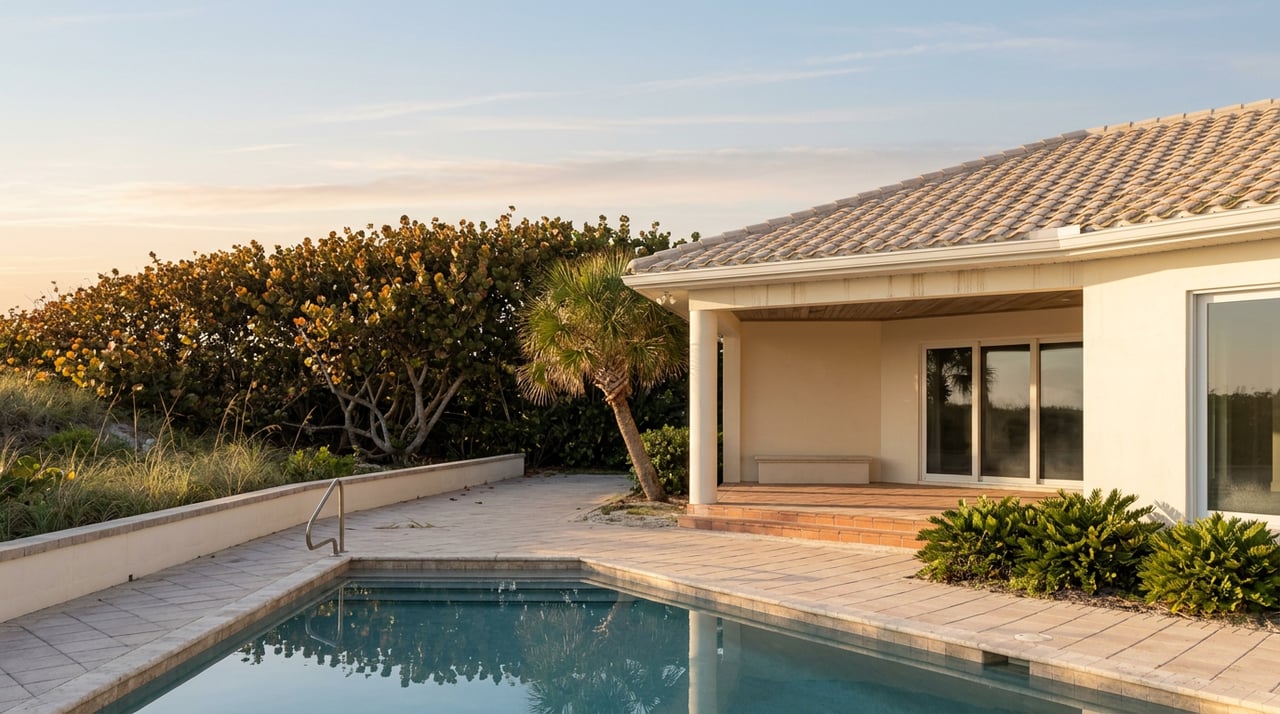
By the third week of October, three things are happening around Hutchinson Island South that have nothing to do with each other and everything to do with the same seven days on the calendar. The beach stays dark at night, as it has since March. Wire traps start going into the water in Manatee Pocket. And somewhere in a garage near the Intracoastal, a captain who hasn't touched his dredge reels since August pulls them down off the wall.
Most descriptions of this island treat fall as a fade-out, the tourist crowd thinning, the humidity breaking, everything getting a little slower and a little quieter. That's true as far as it goes. What it misses is that the island doesn't actually run on one clock. It runs on three, and they don't wind down together. They hand off. If you've lived here through a few Octobers, you've probably felt this without naming it. The specific mechanics are worth naming, because they explain a lot about what you're seeing and hearing outside your own door in October.
The Turtle Clock Runs Out First
Florida's sea turtle nesting season is a fixed window, March 1 through October 31, and it governs a real set of behaviors on this stretch of coast. Hutchinson Island sits inside one of the most significant nesting corridors on the planet for loggerheads, and for months the rule has been simple: keep the beach dark, flat, and clean after sunset. Shielded fixtures, blackout curtains facing the water, no flashlights on the sand after dark. It's not a suggestion. It's been the operating condition of beachfront life here since spring.
That condition expires on a specific date. When November 1 arrives, the lighting restrictions that have shaped how island residents use their own porches and lanais for eight months simply end. It's a small thing on paper and a noticeable thing in practice, the first night you can leave a light on facing the dunes without a second thought. The Florida Oceanographic Coastal Center, sitting right on the island between the Indian River and the Atlantic, has spent the season doing the public education work that makes the rule stick, and by late October their job for this cycle is mostly done. One clock stops.
The Crab Clock Starts Before That One Finishes
Here's the overlap most people miss. Stone crab season doesn't wait for turtle season to end. It opens October 15, seventeen days before the beach lighting rules lift, under a statewide season the Florida Fish and Wildlife Conservation Commission set to run from October 15, 2026 through May 1, 2027. The rule is unusual as far as seafood harvests go: only the claw is legal to take, it has to measure at least 2⅞ inches from elbow to tip, and the crab itself goes back in the water alive to regrow what it lost. It's one of the few fisheries built around the idea that the animal survives the harvest.
What that means for someone who lives on the island is less regulatory and more culinary. For the back half of the year, restaurants on the beach start working stone crab claws onto menus that spent the summer built around mahi and grouper sandwiches. Shuckers, right on the sand, is one of the spots where that shift shows up first. It's a small, specific signal that the season has turned, and it lands seventeen days before the turtle lighting rules do, which means for those seventeen days both clocks are running at once. Dark beach, active traps.
The Fishing Clock Is Already Ticking, Just Not Loudly Yet
The third clock is the slowest to show itself but it's already moving by the time the crab traps go in. Stuart earned its self-given title, Sailfish Capital of the World, off a fishery that lives just offshore of this island, and the mechanism behind it is almost mechanical in its reliability. Cold fronts start sliding down from the mid-Atlantic in early November, pushing north and northeast winds through the inlet, and sailfish start stacking up along what local captains call Sailfish Alley, an informal corridor running parallel to the beach a few miles out. The run typically builds through November and peaks in December and January, sometimes stretching into February depending on how the winter behaves.
But the prep work starts well before the first fish shows up. Boats based out of Sailfish Marina in Manatee Pocket, a five-minute ride from the St. Lucie Inlet, spend October getting rigged. Captains like James Ewing, who runs the charter boat Bone Shaker, and VJ Bell, who's spent more than three decades targeting sailfish out of Stuart aboard the Unbelievable, aren't idle in October. They're the reason the fishery has a reputation at all, and their off-season is this exact window, tackle checked, dredges repaired, boats positioned for a season that technically hasn't started yet but is already shaping their calendar. By the time the first real cold front pushes through, the work that makes the season possible has already happened.
So for about three weeks in October, around this stretch of barrier island, you have a beach still operating under the darkness rules from a season that's ending, crab traps freshly in the water for a season that's just begun, and boats being readied for a season that won't peak for another six to ten weeks. None of the three calendars agrees with the others. That's not an inconsistency. That's just what fall actually looks like here, if you're paying attention to more than one thing at a time.
Even the Resort Reads the Overlap Differently Now
The clearest evidence that this in-between window has become its own thing, rather than just a gap between summer and snowbird season, comes from the biggest commercial operation on the island. The Marriott Hutchinson Island Resort & Beach Villas went through a full reimagining and, notably, didn't just bet on beach chairs and pool bars for the shoulder months. It added Hutch & Local Lanes, a duckpin bowling alley, and a coastal café serving Ess-A-Bagel, the New York import, flown in daily for breakfast and lunch. Neither of those reads as a typical beach-resort amenity. They read as a bet on a guest and a local crowd that isn't purely sun-and-sand and isn't purely deep-winter golf and tennis either. It's the same overlap crowd the turtles, the crabs, and the sailfish captains are all navigating in their own way, just translated into duckpin lanes and bagels.
What This Actually Tells You About Living Here
If you've been on the island long enough to notice the beach getting darker before the fishing talk at the marina picks up, or the crab claws showing up on a menu while turtle nest markers are still standing in the sand, you've been watching this handoff happen without a name for it. It isn't a slow fade from one season to the next. It's a stack of three separate schedules, biological, regulatory, and commercial, that happen to overlap for about two and a half weeks every October. By Thanksgiving, the turtle clock and the crab-opening clock have both settled into their new normal, and the fishing clock is the only one still building toward its peak.
October brings pleasant, cooler temps, but it doesn't change anything about buying, selling, or renting on Hutchinson Island South. It's simply part of the texture of living somewhere that three different natural and commercial rhythms happen to intersect on. If you've ever wondered why October here feels like more than one season at once, now you know why. It is.
If you're a longtime resident who's curious how any of this seasonal rhythm shows up in what your property is actually worth, or if you're weighing a move to this stretch of the island, MOOREMAX Group knows this coastline block by block. Let's Start a Conversation.
This article is general information, not legal, tax or financial advice. Consult a qualified professional about your situation.
